Have you ever walked away from a conversation convinced you had explained something perfectly, only to discover later that the other person had interpreted it completely differently?
Or perhaps you’ve sent an email that seemed clear and concise, only to receive a reply that completely missed the point.
If that sounds familiar, please rest assured that you’re not alone.
One of the most valuable models every Executive Assistant and Personal Assistant can add to their professional toolkit is The Communication Model. It reminds us that communication isn’t simply about what we say – it’s about what the other person actually understands.
For EAs and PAs, whose roles revolve around building relationships, influencing without authority, managing expectations and keeping information flowing, understanding this model can dramatically improve everyday interactions.
Where did the Communication Model come from?
One of the earliest and most influential communication models was developed in 1948 by Claude Shannon and Warren Weaver. Originally designed to improve telecommunications, Shannon and Weaver’s work highlighted something surprisingly relevant to the modern workplace: information can easily become distorted as it travels from one person to another.
Since then, communication theory has evolved, but the same core principles remain true.
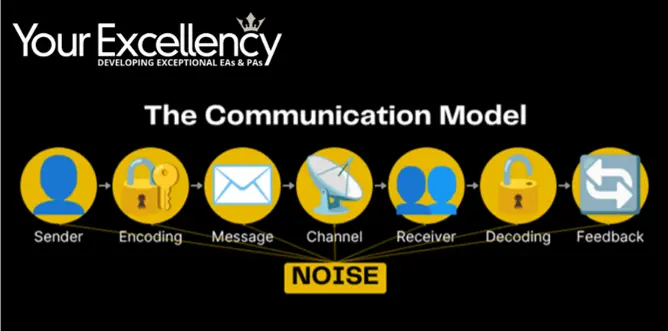
Every conversation contains several key elements:
- The Sender – the person communicating the message.
- Encoding – how the sender chooses to express the message (words, tone, body language, email, Teams message, presentation etc.).
- The Message – the information itself.
- The Channel – the method used to communicate.
- The Receiver – the person interpreting the message.
- Decoding – how the receiver makes sense of what they’ve heard or read.
- Feedback – confirmation that the message has been understood.
- Noise – anything that interferes with communication.
While this appears straightforward, every stage presents opportunities for misunderstanding.
And that’s why the model remains incredibly relevant today.
Why this matters more than ever for EAs and PAs
Today’s EAs and PAs rarely communicate with just one executive.
Many support multiple stakeholders across different departments, countries and even time zones. Communication happens through email, Teams, Slack, WhatsApp, video meetings, phone calls and face-to-face conversations, often switching between channels within minutes.
Add hybrid working, cultural differences, competing priorities and AI-generated content into the mix, and it’s easy to see how messages become diluted.
The modern EA isn’t simply transmitting information.
They’re interpreting, filtering, translating, influencing and often preventing misunderstandings before they happen.
In many organisations, EAs and PAs act as a communication hub that keeps everything moving.
The biggest communication barrier? Assumptions.
One of the most common mistakes professionals make is assuming that because they’ve said something, it’s automatically been understood.
Unfortunately, communication doesn’t work like that.
Every receiver filters information through their own experiences, priorities, emotions, workload and expectations.
Think about these everyday examples:
- Your Executive asks for “the latest figures.” You assume they mean this month’s report. They actually meant the quarterly forecast.
- You send an urgent email. The recipient doesn’t read it until the following morning because they were in back-to-back meetings.
- You explain a new process to a colleague. They leave believing only half of what you intended because they were distracted by another deadline.
None of these situations happen because someone is poor at communicating.
They happen because communication is a shared responsibility.
Understanding “Noise”
When people hear the word noise, they often think about physical distractions.
But in communication theory, noise is much broader.
Noise can include:
- Information overload
- Poorly written emails
- Ambiguous wording
- Stress or emotional pressure
- Technical issues
- Cultural differences
- Different levels of experience
- Assumptions
- Lack of attention
- Interruptions
- AI-generated messages lacking context
As EAs and PAs, reducing noise is often one of your greatest contributions.
Choosing the right communication channel
Not every message belongs in an email.
One of the hallmarks of experienced EAs is knowing how something should be communicated.
Ask yourself:
- Does this need discussion?
- Is speed important?
- Does tone matter?
- Could this be misunderstood?
- Would a quick call solve this faster?
Sometimes a two-minute conversation saves twenty emails.
Feedback: the forgotten step
Many people assume communication ends once they’ve delivered the message.
In reality, that’s only halfway through the process.
Feedback confirms understanding.
It might be as simple as:
“Just to check we’re on the same page…”
or
“Could you summarise the agreed actions before we finish?”
This simple habit prevents countless misunderstandings.
The EA advantage: translating complexity
Exceptional assistants rarely pass information on exactly as they receive it.
Instead, they tailor communication to suit the audience.
They know that the Finance Director may require detail.
The CEO may want a one-page summary.
The Project Team may need clear actions.
The Board may require strategic implications.
Same information.
Different communication.
That isn’t changing the message.
That’s effective encoding.
Five practical ways to improve communication today
1. Pause before pressing Send
Ask yourself:
“Would someone with no background knowledge understand this?”
If the answer is no, add context.
2. Think about your audience
Adapt your communication to the recipient, not your own preference.
Some people love bullet points.
Others prefer conversation.
Some need detail.
Others want headlines.
3. Reduce unnecessary noise
Avoid jargon, acronyms and overly long emails.
The simpler the message, the easier it is to understand.
4. Confirm understanding
Don’t assume.
Clarify.
Summarise agreed actions.
Ask questions.
Encourage feedback.
5. Match the channel to the message
Not everything deserves an email.
Sometimes the quickest route is simply picking up the phone.
The real value of communication
Communication isn’t just about transferring information.
It’s about building trust.
Every clear briefing, well-structured email, carefully facilitated meeting and thoughtful conversation strengthens your credibility.
For EAs and PAs, communication is one of the profession’s most valuable strategic skills.
And, when you understand the Communication Model, you begin to see conversations differently. You stop focusing solely on what you’re saying and start thinking about how your message will be received, interpreted and acted upon.
That’s where communication becomes influence.
And influence is one of the defining characteristics of today’s modern Executive Assistant.
Reflection
Before your next important conversation, ask yourself three simple questions:
- What do I want this person to understand?
- What might prevent them from understanding it?
- How will I know they’ve interpreted it correctly?
Those three questions could transform not only your communication but your impact as an EA or PA.
After all, successful communication isn’t measured by what we say.
It’s is measured by what others understand.