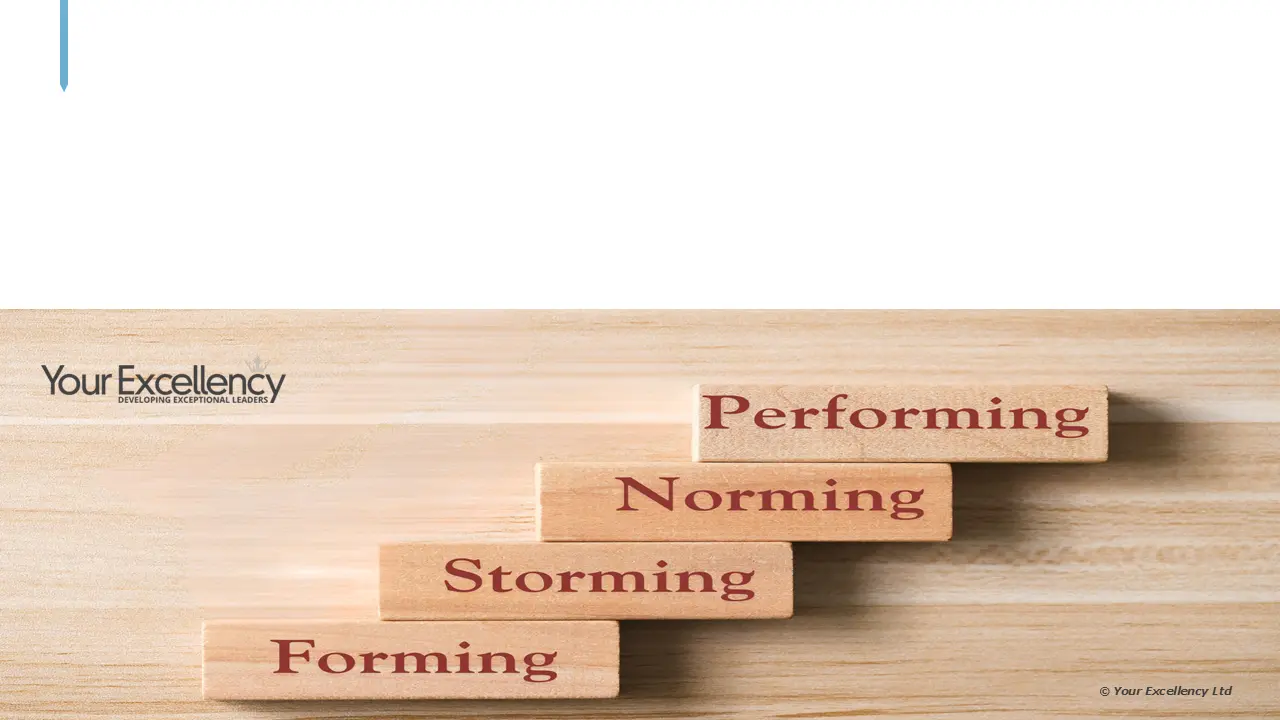
In this post we will consider Team Evolution based on the work of American psychologist, Bruce Wayne Tuckman (1938–2016). Renowed for his work on team dynamics and educational psychology, throughout his career Tuckman contributed significantly to our understanding of group behaviour and learning processes.
In 1965 Tuckman introduced a model outlining the stages of group development in his seminal paper “Developmental Sequence in Small Groups.”. Tuckman’s model identifies four distinct stages that teams typically experience as they evolve: Forming, Storming, Norming and Performing. In 1977 Tuckman added a fifth stage, Adjourning.
Each stage represents a phase in the team’s growth, characterised by specific behaviours and challenges.
As a Team Leader you can fast-track team success by leveraging your leadership skills at each stage of Tuckman’s Model.
Forming
What happens at this stage? What are noticeable behaviours from the team? What challenges may be faced during this phase?
During the Forming stage, team members come together and start to understand the team’s objectives. This phase is often marked by enthusiasm and polite interactions, as individuals are eager to fit in and avoid conflict. However, there may also be anxiety about roles and responsibilities and “stronger” personalities within the team may start to make themselves known.
How can a Team Leader help the team progress to the next stage?
Leaders can facilitate progression by clearly communicating goals, establishing ground rules, and fostering an environment of open communication. Encouraging team members to share their ideas and concerns helps build trust and sets the foundation for effective collaboration.
Storming
What happens at this stage? What are noticeable behaviours from the team? What challenges may be faced during this phase?
In the Storming stage, initial politeness fades as team members begin to express differing opinions and challenge each other’s ideas. As the team “jostles” for position they may lose sight of team and business goals and an unwritten, natural hierarchy may begin to form. This phase can involve conflicts, power struggles, and frustration as individuals assert their perspectives. The team may question the rules, policies and procedures that have been set and there could be a negative impact on productivity and progression. Also, cliques begin to form and the team may separate into smaller sub-groups.
How can the Team Leader help the team progress to the next stage?
Leaders need to address conflicts openly and facilitate constructive discussions to resolve disagreements. Establishing clear roles and responsibilities leveraging individual’s strengths, promoting active listening, and reinforcing common goals can help the team navigate this turbulent phase. Providing support and mediation when necessary ensures that conflicts lead to growth rather than division.
Norming
What happens at this stage? What are noticeable behaviours from the team? What challenges may be faced during this phase?
The Norming stage is characterised by increased cohesion and collaboration. Team members develop mutual respect, establish norms, and align on shared objectives. Communication becomes more open and honest, leading to stronger relationships and a unified approach to tasks. Some challenges may arise in terms of negativity or under performance.
How can the Team Leader help the team progress to the next stage?
Leaders can nurture this harmony by empowering team members, delegating responsibilities, and encouraging autonomy. Recognising achievements and fostering a culture of appreciation will optimise the team’s unity. Continuous support and guidance ensure that the team remains focused and motivated. Negativity and under performance needs to be addressed fairly.
Performing
What happens at this stage? What are noticeable behaviours from the team? What challenges may be faced during this phase?
At the Performing stage, the team operates at a high level of efficiency and effectiveness. Demonstrating the characteristics of an effective team. Members are confident, motivated, and able to handle decision-making without supervision. The focus is on achieving goals, and the team exhibits flexibility and adaptability in the face of any challenges.
The role of the Team Leader should now focus on career succession. Providing coaching and development will help team members to build skills and expertise.
The Fifth Stage: Adjourning
In 1977 Tuckman added the Adjourning stage to the Model. This phase occurs when there is a change in team personnel or the team’s direction. This stage can evoke mixed emotions among team members (alternatively labelled as the “Mourning” phase). Motivation and performance can be impacted as the hierarchy of the team adjusts and the team will go back to the Forming phase of the Model.
The Team Leader needs to be adept at recognising accomplishments, reflecting on lessons learned and helping the team transition again from the Forming stage of the Model.
Bibliography
- Tuckman, B. W. (1965). Developmental sequence in small groups. Psychological Bulletin, 63, 384–399.
- Tuckman, B. W., & Jensen, M. A. C. (1977). Stages of small-group development revisited. Group & Organization Studies, 2(4), 419–427.